Learn About the VolleyStrong Performance System
Volleyball is a game of inches. Whether it is the inch that clears the block, the inch that keeps the ball in bounds on a line shot, or the inch that prevents an ankle from rolling on a chaotic landing, strength is the foundation of those inches.
In this guide, we are going to go beyond the basics. We are going to look at the “Engine” that drives your vertical jump and the “Brakes” that keep your season alive.
The Physics of the Vertical (It’s Not Just Legs)
Most volleyball players believe that to jump higher, they just need to do more squats until their quads burn.
While leg strength matters, it is only one part of the equation. You have to be able to transfer the power you create in your legs up through your body and into the air. If you cannot do that, the strongest legs in the world will not help your vertical.
Think of it this way: have you ever tried to jump as high as you can while standing on a mattress?
Even if you have the most powerful legs on the team, the mattress “eats” your power. Because the surface is soft and unstable, the energy you push into the ground gets absorbed by the mattress instead of pushing you upward. You end up with a tiny jump and a lot of wasted effort.
Now, imagine jumping off a solid, hardwood court.
The floor does not budge. Because the surface is stable, 100% of the force you push into the ground is returned directly back to you, launching you into the air. In your body, your core is that hardwood floor.
If your core is unstable, you are essentially trying to jump off a mattress every single time you transition for a kill.
To jump higher, you must stop the “leaks.” When your core is locked and stable, it acts as a Power Bridge. It ensures that the explosive energy from your legs travels through your torso and into your arm swing without anything being lost in the middle.
<aside>
Want to see exactly how to stop these “power leaks” in your own vertical?
Our 5-day VolleyStrong email course shows you how to build a solid Power Bridge from your own living room.
Sign up for the free VolleyStrong 5-Day Reset here
The Big Four for Volleyball
In volleyball, every play is a combination of fundamental skills: passing, setting, hitting, and serving.
If you haven’t mastered those, the fancy plays don’t matter. Training is the same way. You don’t need a thousand different exercises to get athletic. You need to master the four “Movement Patterns” that every human body is designed to perform.
We call these the “Big Four.”
Think of these patterns as the foundation of your athletic software. Every move you make on the court, from a diving save to a transition jump, is just a variation of these four things. By getting understanding the basics, you make every other move on the court faster, stronger, and more efficient.
1. The Squat (The Defensive Base)
The squat is your “ready” position. Whether you are digging a hard-driven ball or transition-tracking a hitter, you need the ability to hold a deep, stable squat.
- The Athlete’s Goal: Move from a standing position to a deep, stable base in a split second without losing balance.
2. The Hinge (The Jump Trigger)
The hinge is the most misunderstood movement in youth sports. It is not “bending over.” It is pulling your hips back as if you are trying to close a car door with your glutes while your hands are full. This “loads” the hamstrings and glutes, the biggest muscles in your body, to prepare for takeoff.
- The Athlete’s Goal: Create a “tight spring” in the hips that can be released into an explosive jump.
3. The Push (The Block and Strike)
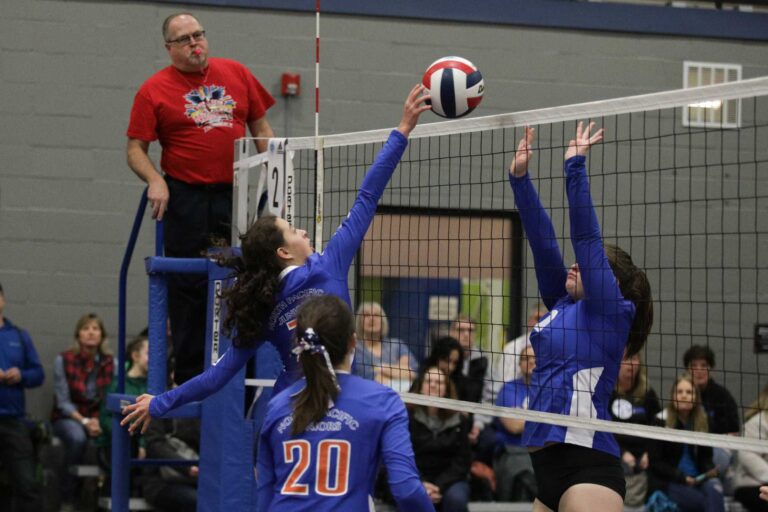
Pushing strength isn’t just about bench pressing. For you, it is about shoulder stability. When you go up for a block, your shoulders have to resist the force of a ball hit at 60 miles per hour.
- The Athlete’s Goal: Build “stiff” shoulders that do not cave when a hitter tries to tool the block.
4. The Pull (The Arm Swing)
The power of your hit comes from the “snap,” but the health of your shoulder comes from the “pull.” The muscles in your back act as the brakes for your arm swing. If those brakes are weak, your body will actually slow down your arm swing to protect the joint from flying out of the socket.
- The Athlete’s Goal: A stronger back equals a faster, safer arm swing.
Durability: The Secret to a Full Season
The best ability is availability. You can have a 30-inch vertical, but if you are sitting on the bench with an ice pack on your knee, that vertical does not help your team win a championship.
The “Sticky” Landing
The majority of ACL and ankle injuries in volleyball happen during the landing phase. When you jump, you are generating massive force. When you land, your body has to absorb all of that force in a fraction of a second.
If your muscles do not know how to act as “brakes,” that force goes straight into your joints.
Training for the “Stick”: Every time you practice a squat or a jump, you should focus on the landing. Your knees should stay tracked over your toes (not caving in), and your hips should absorb the impact quietly. If your landing sounds like a loud “thud,” you are not absorbing force, you are wearing out your joints.
The Psychology of Training
Getting strong is not about “working out.” It is about Training. There is a massive difference.
- Exercise is what you do to burn calories or get a sweat.
- Training is what you do to achieve a specific result on the court.
As a student-athlete, your time is limited. You have school, practice, tournaments, and social lives. You cannot afford to waste time on “filler” exercises. You need the Minimum Effective Dose.
This means doing exactly what is necessary to get stronger without making yourself so sore that you cannot perform at practice. StrengthApp is designed to find that “sweet spot” for you. It uses your baseline data to ensure you are pushing hard enough to grow, but not so hard that you break.
Stop “winging it” in the gym and start training with a professional blueprint.
If you are ready to identify your true strength baseline and master the mechanics of real strength, join our 5-day email course.
Get the free 5-Day VolleyStrong Blueprint here
Your Roadmap to the Next Level
If you want to play at the collegiate level, coaches are looking for two things: Athleticism and Coachability.
Following a structured strength program proves both. It shows you have the discipline to follow a plan and the physical “engine” to compete with the best players in the country.
The 30-Day Reset
Do not worry about what you will be lifting in six months. Focus on the next 30 days.
- Assessment: Take your Broad Jump and Plank baselines today.
- Consistency: Hit your “floor” of 2 or 3 sessions per week.
- Accuracy: Use the “Two-Number Rule” (Load and Volume) to track every set.
- Re-Test: At the end of 30 days, see how much your “engine” has grown.
Final Thoughts from Coach Sam
I created StrengthApp to help educate athletes, veterans, and first responders to improve fitness, increase strength, and avoid injuries. You have the talent. You have the association (CEVA) supporting you. Now, you have the VolleyStrong system.
Strength is not a destination; it is a journey that lasts your entire career.
Whether you are in the gym, in your living room, or on the court during a tournament, remember that you are building a high-performance machine. Treat your body like the professional tool it is.